

Southeast Asia's burgeoning digital economy presents a tantalizing opportunity for startups, yet the path to success is fraught with peril. While the region's rapid growth and dynamic markets are a powerful lure, a sobering reality lies beneath the surface: a staggering 90% of startups worldwide fail, with over two-thirds never delivering a positive return to investors . The primary culprit behind this epidemic of failure is not a lack of funding or fierce competition, but a more fundamental and elusive challenge: the failure to achieve product-market fit.
This report provides a comprehensive analysis of the startup landscape in Southeast Asia, examining the key statistics that define the market and the critical pitfalls that lead to failure. We will delve into the concept of product-market fit, exploring why it is the single most important factor in a startup's success and how its absence becomes a silent killer. By synthesising data from a range of industry reports and expert analyses, this document aims to provide a clear and actionable guide for entrepreneurs, investors, and ecosystem builders seeking to navigate the complexities of this high-stakes market.
The Statistical Landscape of Startup Failure
The statistics on startup failure paint a stark picture of the challenges that new ventures face. While the allure of unicorn valuations and disruptive innovation captures the headlines, the reality for most startups is a struggle for survival.
| Statistic | Description |
|---|---|
| 90% | The percentage of startups that fail worldwide. |
| >67% | The percentage of startups that never provide a positive return to investors. |
| 10% | The percentage of startups that fail within their first year. |
| ~10% | The percentage of startups that survive beyond five years. |
The Primacy of Product-Market Fit
A deeper analysis of startup failures reveals a recurring theme: the inability to find a market that genuinely needs and values the product being offered. This is the essence of product-market fit, and its absence is the leading cause of startup mortality.
42% of startups fail because they never achieve true product-market fit .
34% of startups fail because they don't find the right product-market fit .
Approximately 75% of startup failures are attributed to market or product-market fit issues and challenges with customer adoption .
These figures underscore a critical lesson for entrepreneurs: a brilliant idea, a talented team, and ample funding are all for naught if the product does not resonate with a real and substantial market need.
The Southeast Asian Context: A Market of Contrasts
Southeast Asia is not a monolithic market; it is a diverse and fragmented region with a wide range of economic, cultural, and regulatory landscapes. This diversity presents both opportunities and challenges for startups seeking to expand into the region.
Funding and Investment Trends
The flow of venture capital into Southeast Asia provides a key indicator of the region's startup ecosystem's health. While the overall trend is positive, the distribution of funding is highly concentrated.
1) In the first half of 2025, Southeast Asian tech startups raised approximately $2 billion, a 7% year-over-year increase.
2) However, this growth was driven by a 140% surge in late-stage deals, while seed funding declined, indicating a "shrinking middle" in the startup ecosystem.
3) Singapore continues to dominate the region, capturing about 92% of total startup funding and 88% of fintech funding in the first half of 2025
Survival and Density
Despite the challenges, some markets in Southeast Asia demonstrate a surprising degree of resilience.
FACT 1) Bangkok startups have a survival rate of approximately 55% after three years, which is higher than many global averages .
FACT 2) However, the overall startup density in Asia remains low, with an average of 3 startups per 100,000 inhabitants, compared to nearly 40 in OECD countries
The Anatomy of Failure in Southeast Asia
The reasons for startup failure in Southeast Asia are a complex interplay of universal challenges and region-specific obstacles.
Primary Reasons for Failure
Failing to meet market needs (35%) This is the most common reason for failure, highlighting the critical importance of product-market fit.
Being outcompeted (20%) The competitive landscape in Southeast Asia is fierce, with both local and international players vying for market share.
Inability to raise new capitalThe funding winter has made it increasingly difficult for startups to secure the capital they need to survive and growStructural Barriers to Growth
Beyond these immediate causes of failure, there are deeper, structural barriers that hinder startup growth in the region
| Component | Key Challenges |
|---|---|
| Regulatory Fragmentation | The lack of harmonised regulations across ASEAN countries creates significant compliance burdens and makes cross-border expansion a complex and costly endeavour. |
| Market Entry Hurdles | Startups face a gauntlet of challenges when entering new markets, including complex compliance requirements, foreign ownership restrictions, and a lack of transparency. |
| Commercial Misalignment | The "one-size-fits-all" approach rarely works in Southeast Asia. Startups often struggle to adapt their products and business models to the diverse cultural and consumer preferences of the region. |
| Investment Constraints | Access to capital remains a significant challenge, particularly for early-stage and mid-stage companies operating outside of major hubs like Singapore |
The Perils of Premature Scaling
The pressure to grow quickly can lead startups to a fatal error: premature scaling. Scaling before achieving true product-market fit is akin to building a skyscraper on a foundation of sand. It amplifies existing problems and accelerates the path to failure.
"False product-market fit is the silent killer of early-stage startups."
The consequences of premature scaling are severe
| Component | Pitfall |
|---|---|
| Skyrocketing Customer Acquisition Costs (CAC) | Without a clear understanding of the target market, marketing spend becomes inefficient and unsustainable. |
| Product Bloat | In a desperate attempt to find a market, startups often add unnecessary features, leading to a confusing and unfocused product |
| Increased Burn Rate | Scaling operations without a corresponding increase in revenue quickly depletes cash reserves, shortening the startup's runway |
| Operational Chaos | The entire organisation is thrown into a state of disarray, with teams working hard but making little meaningful progress. |
| Miss hires | Hiring the wrong people without the domain and network experience |
At H&F Advisers, we work with founders and business leaders who are building ambitious products with bold visions. But often, despite their speed and passion, they’re not landing where it matters most. They're launching fast, iterating constantly, and doing all the right things yet still find themselves stuck in the gap between potential and traction.
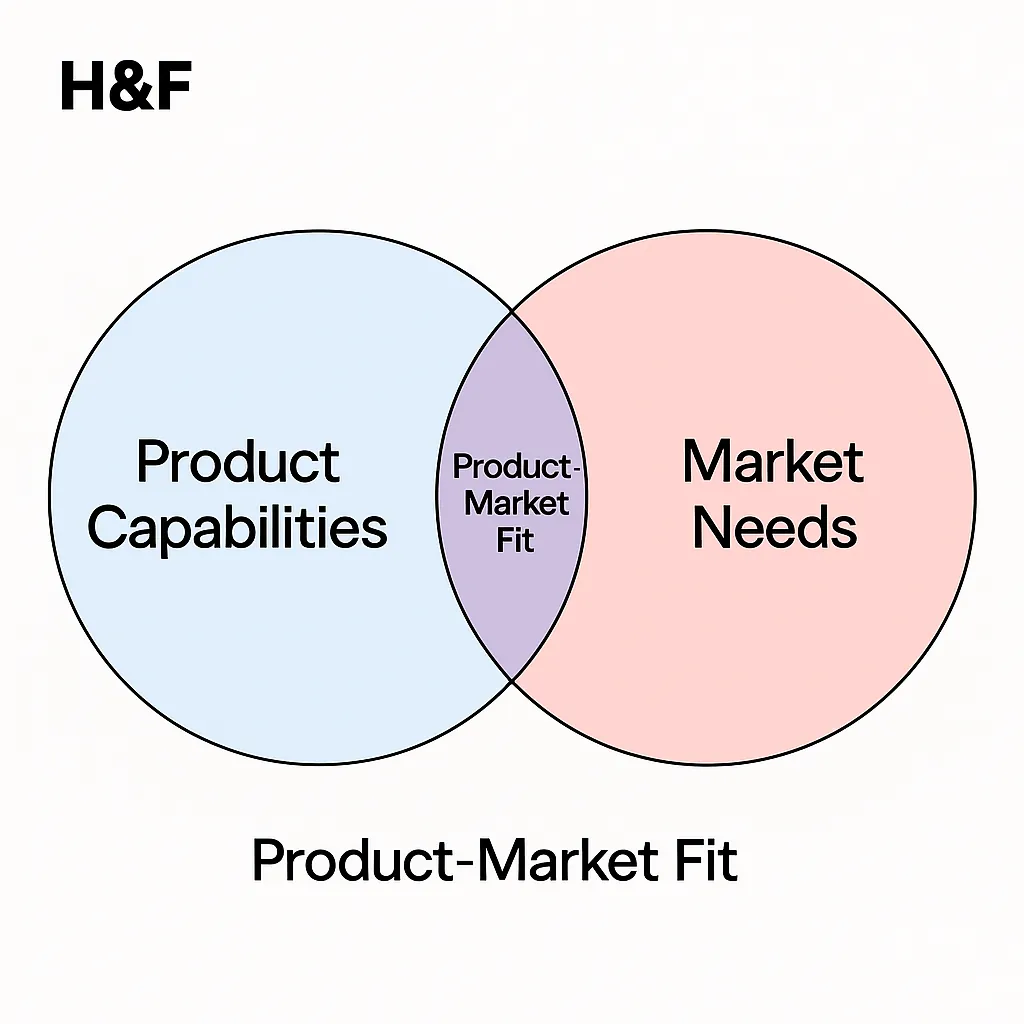
This is where product-market fit comes into focus. It's not just a checkbox on a roadmap or a mythical milestone that "just happens." It's the moment your product truly earns the right to grow. It's the difference between building something that exists and building something that sticks. When you've hit product-market fit, your users don't just tolerate your product they want it, use it, pay for it, and recommend it. They understand it without hand-holding. They come back without being chased. They advocate for it without being asked.
Contrary to popular belief, product-market fit isn't about having a perfect product. It’s about solving a real, meaningful problem for a clearly defined audience in a way that’s more compelling than the alternatives. It’s messy, non-linear, and often elusive. But once it clicks, growth stops feeling forced and starts feeling inevitable.
This is where H&F comes in.
We work with early-stage and growth-stage companies navigating the chaotic middle ground between idea and traction. Our mission is to bring clarity where there’s noise, and progress where there’s paralysis. We partner closely with leadership teams to challenge assumptions, pressure-test hypotheses, and refine positioning because the path to product-market fit isn’t paved with more features, but with sharper focus.
We start by working with teams to truly define who they’re building for. This goes far beyond basic personas or market segments. It means deeply understanding user motivations, pain points, and decision-making contexts. It means knowing not just what your users say but what they do, what they avoid, and what they’ll actually pay for. Only from this clarity can effective decisions be made about product design, messaging, and channel strategy.
Next, we help refine the value proposition to ensure your offering speaks powerfully to those you aim to serve. Too many products try to do too much or say too little. We work with teams to strip things back, highlight the real differentiator, and express that value in a way that lands instantly. Whether it's about pricing, positioning, or storytelling, we distill your product’s core into something unforgettable and commercially effective.
But clarity and strategy alone aren’t enough. Real progress comes through real-world validation. At H&F, we embed rapid feedback loops into everything we do. That means getting your product or prototype into the hands of the right users, watching how they interact, and turning those observations into practical iterations. Whether it’s a pilot with early customers or a lightweight MVP test, we help you learn fast and adapt faster so you're not just iterating for the sake of activity, but for actual traction.
What makes H&F different is how we work. We don’t just advise from a distance. We integrate deeply and move quickly. As fractional GTM and strategy partners, we become an extension of your team helping you think clearly, act decisively, and execute with confidence. Our engagements are designed to be short, sharp, and focused on inflection points. Over three to six months, we build the strategic infrastructure and momentum you need to break through.
Operating across Southeast Asia and beyond, we bring not only experience and insight but also deep cultural understanding and operational empathy. We've seen what works and what doesn’t in diverse markets, and we know how to translate strategy into action, even in complex, fast-changing environments.
Finding product-market fit is hard. Doing it alone is even harder. If you're at the stage where you can sense product-market fit but can’t quite grab hold of it, H&F can help you close that gap. Not with more theory but with structured, actionable partnership designed to unlock clarity, speed, and results.
Conclusion A Call for Strategic Patience
The data is clear: the path to startup success in Southeast Asia is a marathon, not a sprint. The pursuit of product-market fit must be the central focus of any early-stage venture. This requires a deep understanding of the target market, a willingness to iterate and pivot, and the strategic patience to resist the siren song of premature scaling.
For entrepreneurs, the lesson is to prioritize learning over growth in the early stages. For investors, it is to look beyond vanity metrics and focus on the underlying indicators of true product-market fit. And for the ecosystem as a whole, it is to provide the support and infrastructure that startups need to navigate the complexities of this dynamic and challenging region.

Mike Rourke is a Product and Operations Partner at H&F Consultancy, with over 18 years of experience driving scale and innovation across fintech, digital assets, and financial services. From institutional banks to early-stage startups, Mike has led global product-market fit and GTM strategies across 56 markets. His work sits at the intersection of commercial impact and customer insight—translating complex products into sustainable, high-growth businesses.Interested in finding product market fit in South East Asia? Let’s talk about how H&F fractional consultants can help you work smarter—starting today email Mike at our contact form