

In a fast-moving market, it’s not enough to have a strategy—you need one that’s clear, actionable, and built to evolve. At H&F, we work with businesses across Southeast Asia to optimise strategy not just at the planning table, but where execution happens. Whether you’re scaling a startup, entering a new market, or navigating uncertainty, refining your business strategy can unlock clarity, speed, and sustainable growth.
Strategy Optimization Funnel
To help visualise the journey from insight to impact, we use a funnel-based approach:
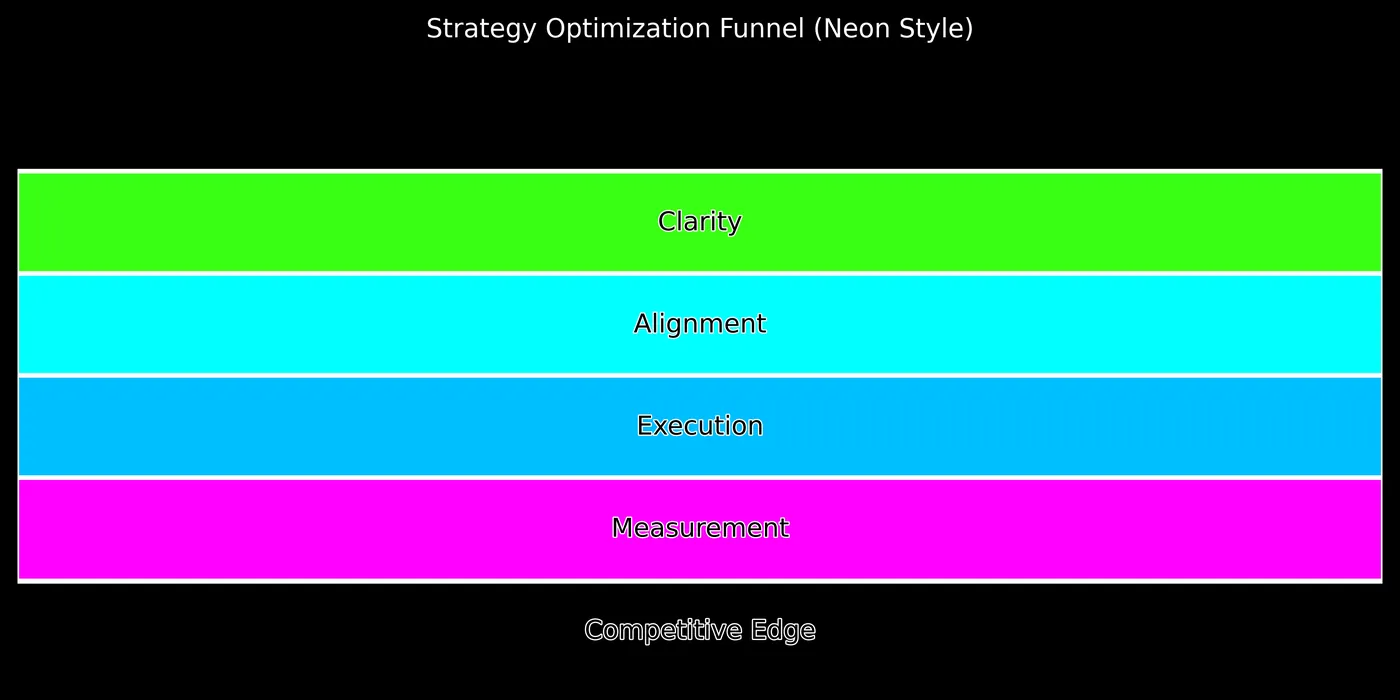
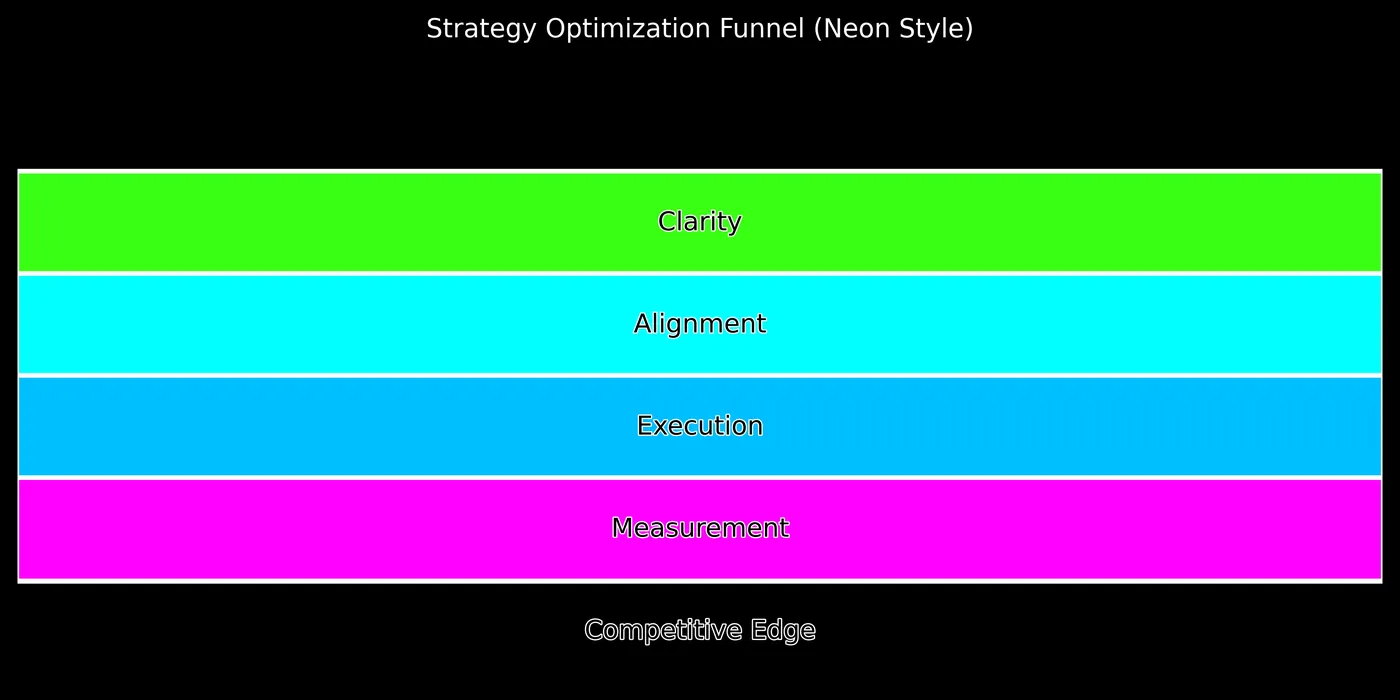
Each layer of the funnel supports and sharpens the one above it—ensuring that strategic clarity leads all the way through to competitive advantage.
Start with Alignment
Many strategies fail not because they’re poorly crafted, but because they’re misaligned. Optimising strategy means syncing your ambition with three realities:
- Your current business stage (early growth vs. scale-up vs. reinvention)
- Market dynamics (competitive pressures, regulatory changes, customer needs)
- Team capabilities (what your current people and processes can actually deliver)
At H&F, we conduct deep-dive alignment workshops to reassess your strategic foundations, ensuring your goals are realistic, structured, and ready for execution.
Focus on What Moves the Needle
Strategic clarity doesn’t mean doing more—it means focusing on what matters.
We help leaders:
- Identify the 2–3 levers that create the most impact
- Say no to distractions, vanity metrics, or resource-draining initiatives
- Double down on high-performing channels, products, or partnerships
Example Prioritisation Framework, incorporated by all H&F Fractional Consultants.
| Priority | Initiative | Impact | Effort | Decision |
|---|---|---|---|---|
| 1 | Expand top Performing GTM Channel | High | Low | Go |
| 2 | Rebrand Website | Medium | Medium | Later |
| 3 | Launch new product line | Low | High | Pause |
Design for Execution
The most beautifully worded strategy is meaningless if it can’t be executed.
Execution design at H&F includes:
- Clear work streams, owners, and timelines
- Cross-functional planning between product, sales, ops, and finance
- A feedback loop for weekly review, monthly course correction, and quarterly recalibration
We believe “Execution = Strategy” and bridge the gap between slides and outcomes.
Build for Scalability
Markets shift. Teams grow. Technology changes. The best strategy embraces change without losing direction.
We embed scalability principles:
- OKRs and KPIs that evolve with the business
- Decision checkpoints that keep leaders agile
- Templates and playbooks for onboarding new teams without reinventing the wheel
Whether you’re 10 people or 1,000, your strategy should stay sharp, not static.
Agility is no longer optional it’s foundational. Markets shift overnight. Teams double in size in a quarter. Technologies that seemed essential a year ago can become obsolete by next spring. Amidst this constant flux, the businesses that thrive are those that build their strategy for scalability, not just stability.
Too often, companies approach strategy as a static document a vision etched in stone. But in reality, a winning strategy is a living system: one that evolves with context, feeds on feedback, and scales with confidence.
Scalability means that your strategic framework remains
- Relevant when your customer base expands
- Functional when your team grows from 15 to 150
- Actionable when your market shifts or regulations tighten
In short, scalability isn’t about preparing for every possible change it’s about preparing to adapt intelligently.
Three Principles for Scalable Strategy
At H&F, we embed three key principles into every strategy we co-create with our clients. These principles ensure the strategy remains a north star, even as everything around it moves.
1. Evolving OKRs and KPIs
Static goals are a liability. We design Objectives and Key Results (OKRs) and Key Performance Indicators (KPIs) that grow alongside the business.
- Early-stage teams may focus on product-market fit or pipeline velocity.
- Growth-stage companies shift toward retention, unit economics, and NPS.
- Mature organizations may measure governance, sustainability, or margin resilience.
Our approach ensures measurement systems evolve with strategy—so you’re always tracking what matters most.
2. Decision Checkpoints for Agility
Scalable strategies include built-in checkpoints for decision-making. These aren’t just calendar-based reviews—they’re purpose-built triggers that help teams pause, reassess, and redirect if needed.
Examples:
- A 20% drop in CAC triggers a channel review.
- A missed quarterly revenue target prompts a go-to-market adjustment.
- Crossing 100 FTEs opens up an organizational redesign workshop.
These checkpoints prevent strategic drift and empower teams to course-correct without waiting for a crisis.
3. Reusable Templates and Onboarding Playbooks
As companies grow, knowledge and processes must be codified, not improvised. We develop lightweight, scalable toolkits that help new teams and hires get up to speed fast—without reinventing strategy from scratch.
Some examples:
- OKR drafting templates for new departments
- Market entry playbooks for regional expansion
- Onboarding guides for new leaders aligned to strategic priorities
Let’s Make It Scalable
At H&F, we work with tech companies, fintech disruptors, and forward-thinking enterprises to turn strategic intent into scalable systems. We help teams build frameworks that evolve—so their business can, too.
Want to future-proof your strategy? Let’s talk.
About Sarah Huang Fractional Cheif of Product & Commercial Officer
Sarah Huang is a seasoned innovation leader, known for helping high-growth companies translate vision into scalable execution. With a background spanning fintech, open banking, and AI-driven solutions across Southeast Asia, Sarah brings a rare mix of commercial acumen, product insight, and operational rigor. As a fractional executive and advisor, she partners with founders, C-suites, and investors to design strategies that don’t just sound good—they work, most importantly, she anchors teams and empower individuals to execute, by leading examples. Her approach to strategy optimisation centers on clarity, speed, and systemic thinking—anchored by a deep understanding of what it takes to build for scale in complex, fast-moving markets.