
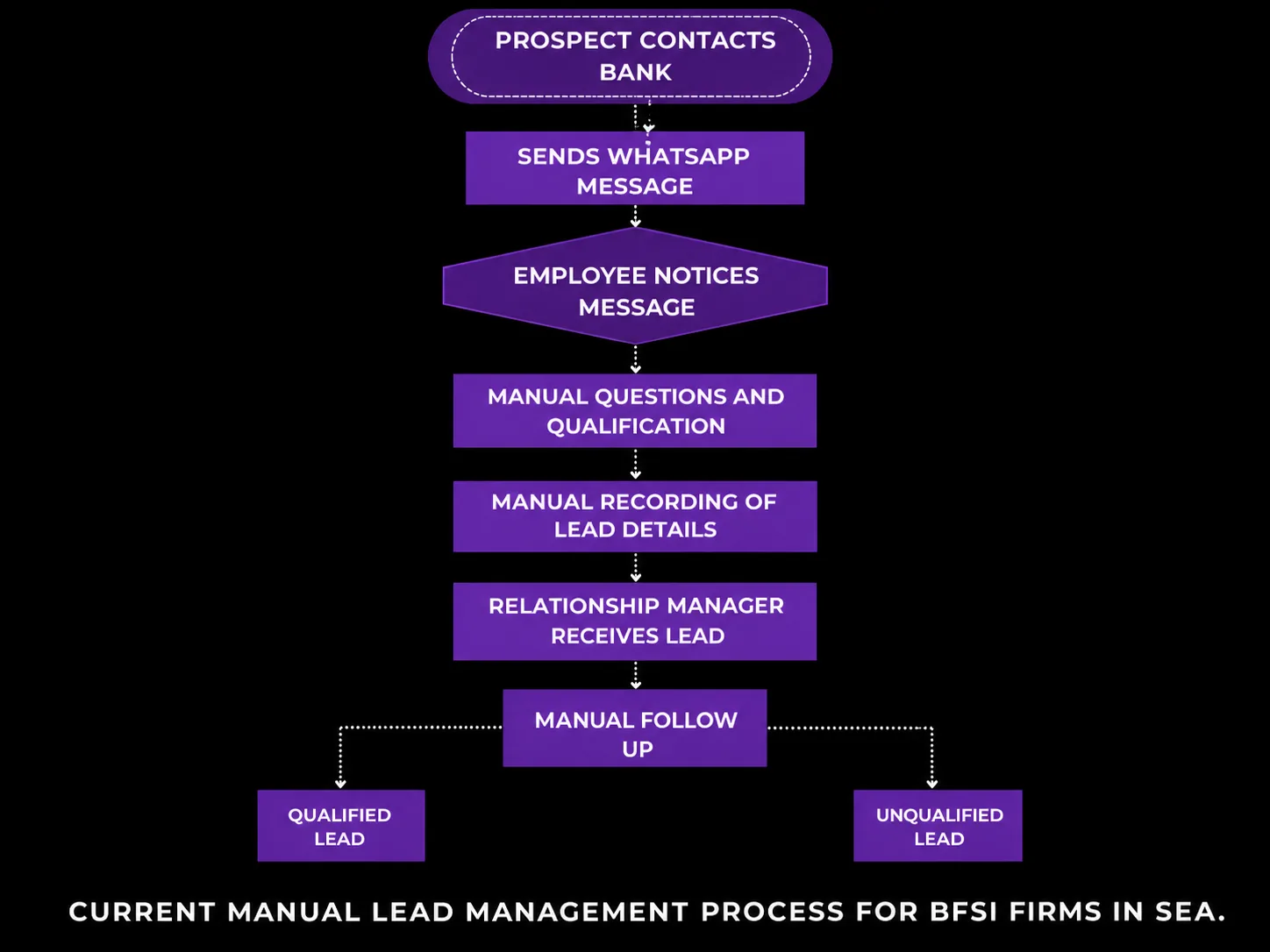
For BFSI firms expanding across Southeast Asia, the real challenge isn't finding leads—it's what happens after a prospect sends that first WhatsApp message.
A bank might spot an opportunity through a local partner, an industry event, or a referral. The prospect reaches out asking about a product or a meeting. At that point, the clock is ticking. But when that first reply depends on someone manually spotting the message, figuring out what the prospect needs, asking the right questions, logging it, routing it to a relationship manager, and remembering to follow up—things fall apart fast. Multiply that across several SEA markets, and it simply doesn't scale.
The issue isn't slow teams. It's a process stitched together with too many manual steps and handoffs across fragmented local operations. That's the kind of friction that hides in plain sight—not a dramatic bottleneck, just quiet inefficiency. The fix starts with mapping the value stream before trying to improve it.
So this article zooms in on one workflow: WhatsApp lead management for BFSI firms entering or scaling in Southeast Asia. Not AI across every department—just one problem, end to end: how a financial institution can better receive, qualify, record, route, and follow up on WhatsApp leads across the region.
The approach follows a familiar business analysis structure—understand the need, analyze current and future states, define requirements, design, and evaluate. It doesn't have to be rigid; it can move iteratively depending on the initiative.
The point is straightforward: understand the problem before you automate it.
Start With The Business Problem, Not The AI
A common mistake with automation is starting with the technology—saying "we can connect WhatsApp to an AI model." True, but it skips the real question: what problem are we solving?
For BFSI lead management in Southeast Asia, the problem is specific. Prospects are reaching out, but responding, qualifying, recording, and routing those leads still depends heavily on manual work across multiple markets. That creates friction.
During quiet periods, a firm might handle the volume fine. But as leads grow across SEA markets, the same manual workflow brings delays, inconsistent replies, missed follow-ups, and extra admin work for relationship managers.
So the first step isn't building an AI chatbot. It's understanding the existing process. You can't improve a flow you haven't mapped.
Understanding The Current State
Before designing an automated workflow, the current lead management process should be mapped.
This is not just a theoretical problem. It is a documented reality across the region.
The Channel: WhatsApp dominates BFSI communication in Southeast Asia. Infobip's 2026 Messaging Trends Report found that WhatsApp accounted for 91% of conversational AI interactions in Asia Pacific, with mobile messaging surging 240% in Malaysia during 2025. In high context markets like Indonesia and the Philippines, messaging apps are the primary channel for relationship building, not email.
The Spreadsheet Problem: Manual recording harms data accuracy and follow ups. A Formstack customer story documented that Great Plains Brokerage experienced leads piling up due to slow manual processing. Separately, a life insurance automation case study published by WonderBotz reported that manual data entry across legacy systems created errors and delayed underwriting, requiring 4 full-time employees just to manage 40,000 applications annually.
The Follow Up Failure: Manual follow up drives revenue loss. Insurtech research citing IRDAI annual report data found that 45% of policy lapses stem from forgetfulness and 30% from a confusing renewal process (Rootle.ai; ProductGrowth.in). Both are symptoms of poor automated engagement. In private banking, 35 to 50% of client relationships are unprofitable. This happens largely because RMs lack bandwidth
The RM Burden: RMs across BFSI struggle with manual processes.McKinsey research found that commercial banking RMs spend only 25 to 30% of their time in client dialogue. The rest goes to prospecting, research, and data entry (McKinsey & Company, Commercial Banking Survey). Employee reviews on Glassdoor and Indeed for major Singapore banks, including Bank of China Singapore and CIMB, confirm that outdated infrastructure leads to manual processes that affect workflow efficiency.
Mapping the process this way shifts the conversation from "we need an AI Chatbot" to "we have a process with several manual handoffs that can be improved." That shift in framing is the actual business analysis mindset.
Identify The Root Cause
So why is the process inefficient? Not because teams can't handle leads.
The causes are structural. Responses depend on who's available across time zones. Qualification questions get repeated by hand every time. Prospect details are entered manually into multiple systems. Relationship managers often get incomplete context. Follow-ups rely on someone remembering rather than a system prompting. As volume grows, admin work grows with it—but capacity doesn't. There's usually no consistent way to prioritize leads across markets, and management has little visibility into where things actually stall.
This is where process analysis, process modelling, root cause analysis, stakeholder analysis, and KPI tracking come in. The goal isn't to automate everything. It's to find where the friction is worst and where automation can deliver measurable value.
What BFSI Adopters Have Already Proven
The operational problem described above is not theoretical. Banks across multiple markets have already deployed WhatsApp lead management systems at production scale, and their measured results confirm that the structured approach works.
| Institution | Use Case | Measured Result |
| Banco Mercantil (Brazil) |
AI assistant “Mel” qualifies and onboards loan applicants via WhatsApp |
51% of WhatsApp-started customers acquired at least one credit product; 40% of total sales attributed to WhatsApp(Meta) |
| Agibank (Brazil) | Agentforce SDR agent qualifies leads, hands off to reps | 22,500 loan inquiries resolved monthly with 75% deflection rate(Salesforce—Agibank |
| Multinational Public Sector Bank (India) | AI/NLP virtual assistant for banking services and campaigns | 18% lead-to-sales conversion; 4M+ interactions handled(Twixor — Public Sector Bank ) |
| Banco Bolivariano (Ecuador) | Virtual agent automating WhatsApp inquiries | 98% of inquiries automated; 46% reduction in call center volume(Infobip — Banco Bolivariano ) |
These are not pilot programs or speculative projections. Banco Mercantil measured performance over a full year (June 2024–June 2025) and attributed 40% of its sales share directly to WhatsApp(Meta) . Agibank deployed its loan status agent and saw measurable value within three weeks(Salesforce — Agibank). The pattern is consistent: banks that map the process first, then automate the repetitive stages, achieve capacity gains that manual workflows cannot match.
For firms entering Southeast Asia, the relevance is direct. The same manual handoffs that slow response times in Brazil or India exist in SEA markets, often amplified by multi-country operations and localised customer expectations. The adoption curve is earlier in SEA, which means the operational advantage is still available to firms that move now.
Define The Business Requirements
Once the current process is clear, the next step is working out what the improved process needs to do.
For BFSI WhatsApp lead management, that means a few core things. Prospects should get an instant acknowledgement instead of waiting hours. Qualification questions should be asked automatically and consistently, not left to whoever's at their desk. The system needs to understand what the prospect is asking for, capture the details without re-typing, and sort enquiries into categories. Qualified leads should then go to the right relationship manager with enough context to act. There should be a follow-up workflow so leads aren't forgotten, a clear path to a human when things get complex, and a record of everything. And it has to be measurable—otherwise there's no way to know if it's working.
None of this is really about AI. The requirement is simple: capture and qualify WhatsApp leads quickly and consistently across SEA markets. AI is just one way to do that. Banks that got this right treated it as a lead qualification problem first and an AI project second. That order matters—it stops a firm from buying technology just because it's available.
Define The Future State
After understanding the current process, the next question becomes what the process should look like after improvement. The future state moves repetitive activities into an automated workflow while keeping people involved where human judgement is valuable.
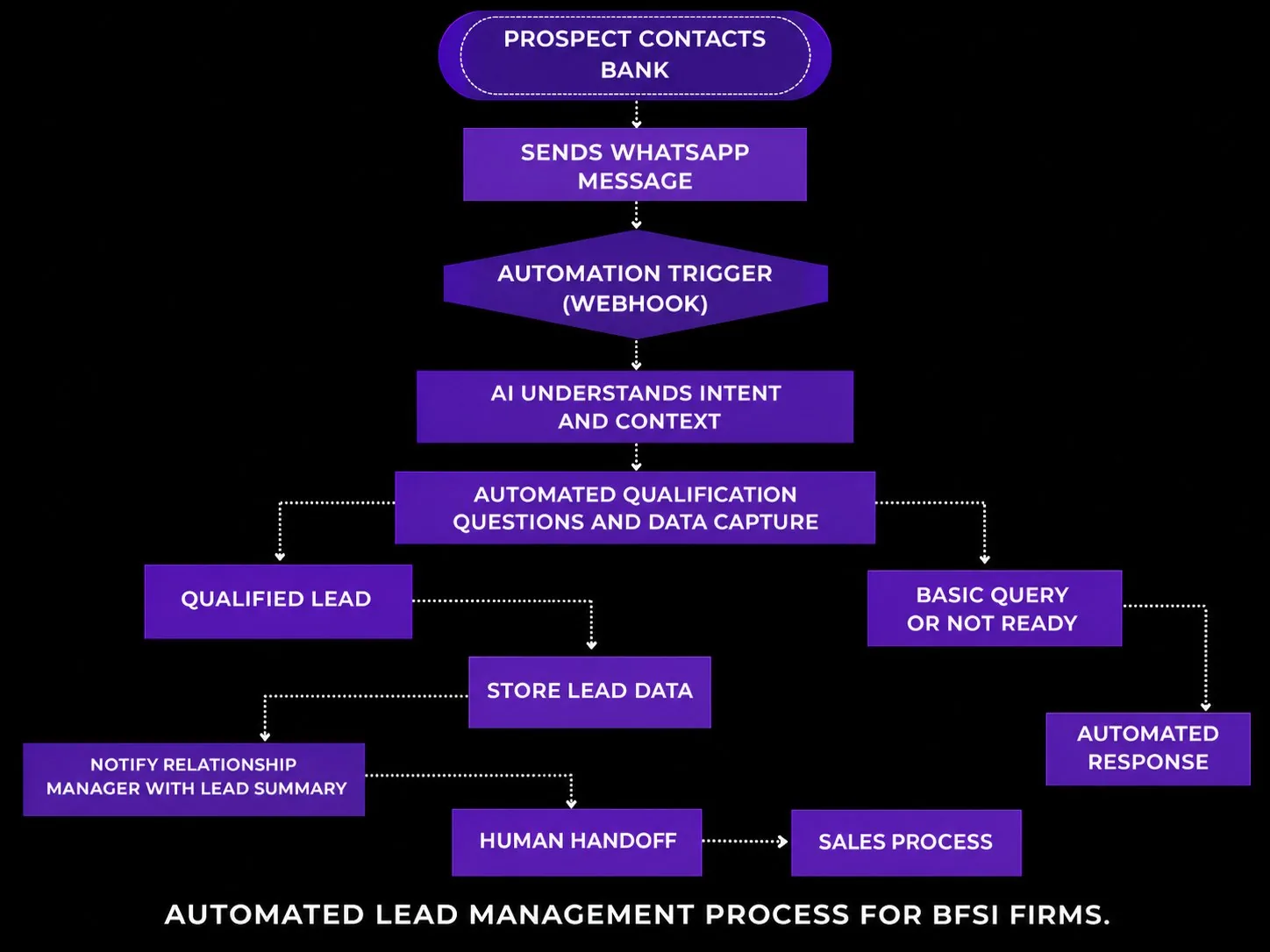
In the traditional process, humans perform almost every step. In the future state process, automation handles the repetitive activities while teams remain responsible for higher value interactions and decisions.
Where AI Fits Into The Workflow
AI is useful for understanding customer intent, asking relevant qualification questions based on what has already been provided, and generating a short summary once qualification is complete. The goal is to collect what the relationship manager actually needs so the handoff is clean.
The Role Of Workflow Automation
A workflow automation platform connects the WhatsApp channel, the AI model, the CRM or database, and the notification system into a single automated process. The choice of platform matters less than the design of the workflow itself.
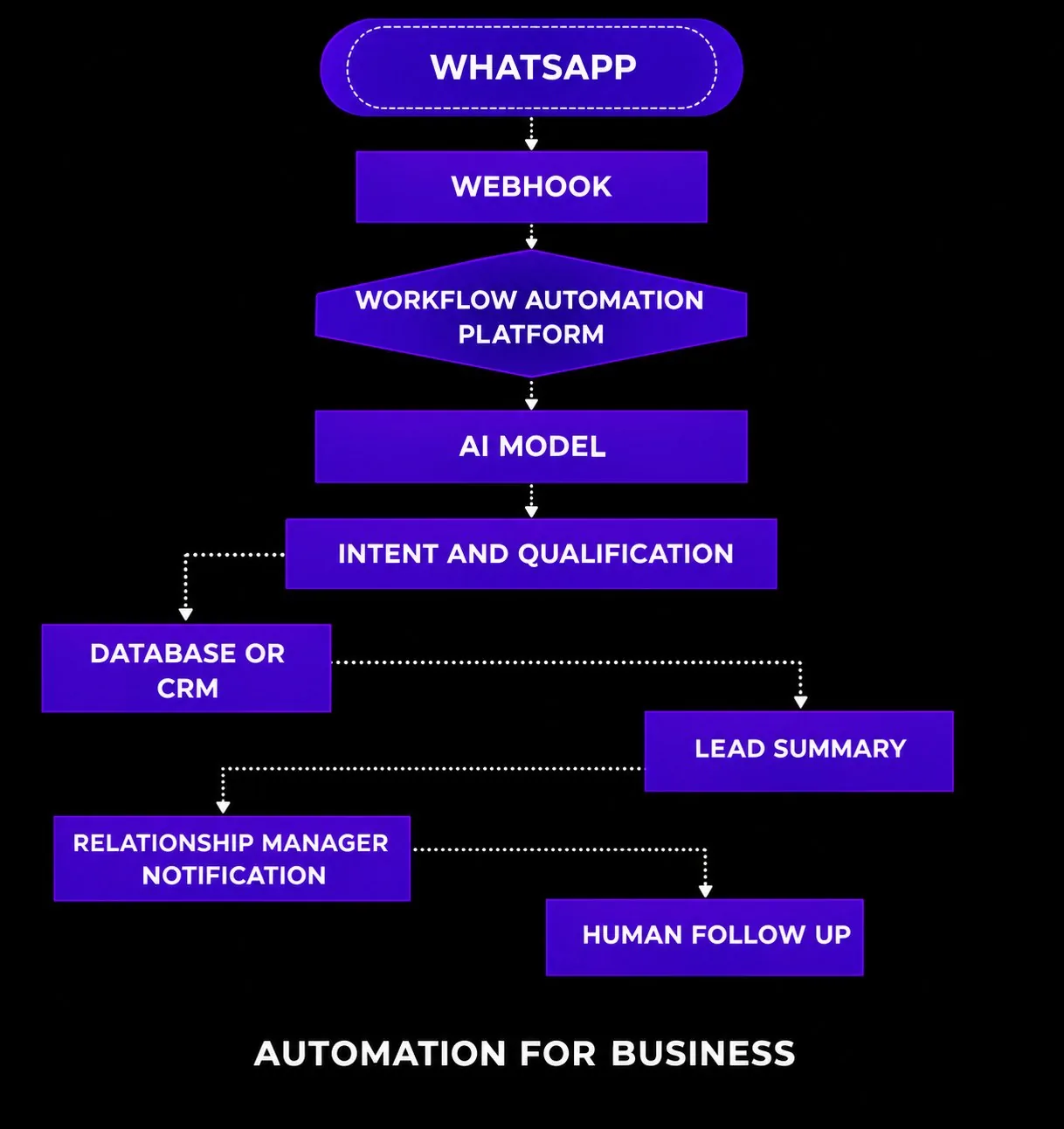
The trigger for this workflow is typically a webhook. When a prospect sends a WhatsApp message, the messaging platform sends an automatic signal, called a webhook, to the workflow system. That signal starts the automation: the message is passed to the AI model, intent is identified, qualification questions are asked, and the lead data begins to flow through the process without anyone manually checking for new messages. The value does not come only from selecting an AI model. The value comes from understanding the business process and designing a system around the actual requirement.
Human Handoff Is Part Of The Design
A good automation system should not attempt to automate every conversation. Human handoff should be treated as a requirement rather than an afterthought. Automation handles repetitive and structured tasks. People handle situations where context, judgement, negotiation, or relationship building genuinely matters.Not every inbound message requires human involvement. If a prospect has a basic query or is not ready to proceed, the system can send an automated response with relevant information and keep the lead in a nurture track for future follow-up.
Measuring Whether The Solution Actually Works
Building the workflow is not the end of the project. The important question is whether the new process created real business value.
This connects directly to the solution evaluation discipline within business analysis, which focuses on assessing the performance, value, and limitations delivered by a solution. Its tasks include measuring solution performance, analyzing performance measures, assessing limitations, and recommending actions to increase value.
For BFSI WhatsApp lead automation, useful KPIs include average first response time, the percentage of leads receiving an immediate response, total leads processed, qualification completion rate, follow up completion rate, relationship manager handling time, lead to opportunity conversion, and the number of leads lost due to delayed response. Tracking these turns automation from a technology experiment into a measurable business initiative
Stats & Comparisons
Business Analysis and Operational Comparison
| Area | Manual Process | AI Automated Process |
|
Initial response |
Depends on employee availability |
Automated response |
|
Lead qualification |
Manual questions |
Structured automated qualification |
|
Data entry |
Manual |
Automated capture |
|
Lead summary |
Employee prepares information |
AI generates summary |
|
Sales notification |
Manual handoff |
Automated notification |
|
|
|